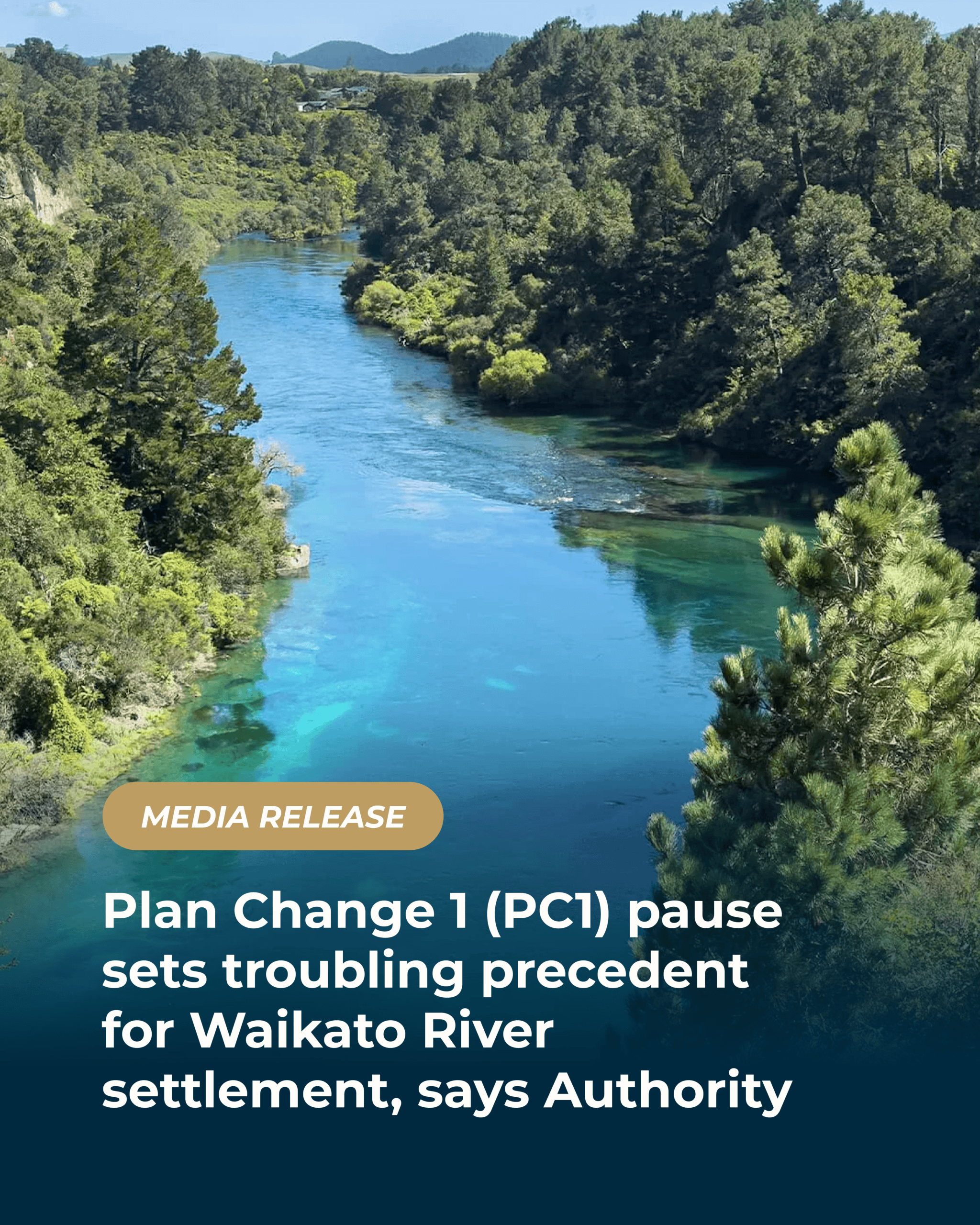
The Waikato River Authority is deeply disappointed by the Government’s decision to defer Plan Change 1 requirements until 2032, saying it will set back progress towards restoring the Waikato and Waipā Rivers within the agreed 80-year timeframe.
Under the deferral, Farm Environment Plan (FEPs) and their associated requirements for farmers to adopt best environmental practices to mitigate contaminant losses, which PC1 would have triggered, will be put on hold until the end of 2032. The Authority acknowledges that many farmers are already proactively undertaking good environmental work. However, these efforts will have limited impact without clear bottom lines to hold those who are not meeting the required standards to account.
WRA Co-Chair Stu Kneebone said the deferral pushed back a milestone the Environment Court had already confirmed as an essential first step toward Te Ture Whaimana, a vision that looks 80 years out to a healthy, swimmable river.
“We’ve got an 80-year journey to restore and protect our awa. Every year PC1 is deferred adds another year to that timeframe and pushes the restoration of our already significantly degraded awa further away.”
Mr Kneebone said the Court had already weighed this trade-off and found against delay, a finding that stings given the Authority has invested more than $80 million into almost 500 restoration projects across the Waikato River catchment over the past 15 years.
“The Court was clear: delay risks further degrading a river system already under pressure. That finding hasn’t changed. What has changed is that we’re passing the buck to the next generation. In the meantime, farmers who most need to improve can continue operating under existing permitted activity rules, without an FEP or any requirement to improve their environmental practices until 2032. That amounts to a free pass to keep polluting the awa.”
The Authority acknowledged that controls on land-use change and intensification through resource consents remain in place. It also noted the Government’s commitment that any future Natural Environment Plan for the region must have particular regard to PC1, recognising the unique statutory role of Te Ture Whaimana. However, Co-Chair Danny Loughlin questioned whether the Government’s assurances could be relied upon, given its decision to defer PC1.
“We take some comfort that the work behind PC1 is not being erased and that whatever comes next must have regard to it. But ‘have regard to’ in a plan that is still years away is not the same as “giving effect” on the ground today,” Mr Loughlin said.
The Authority said it would continue to work with Waikato Regional Council, central government, iwi, industry and catchment communities to press for genuine progress during the deferral period. It reiterated that restoring the Waikato and Waipā Rivers is a collective responsibility: Mā rau ringa e ora ai te awa – we need everyone contributing for the river to thrive.
Media contact
Te Anga Nathan
Pou Kōrero, Waikato River Authority
teanga@waikatoriver.org.nz
021-325-701
About the Waikato River Authority
The Waikato River Authority is an independent statutory co-governance body established in 2010 through the Waikato River Treaty Settlement legislation. Made up of equal Crown and iwi representatives, the Authority is the custodian of Te Ture Whaimana o Te Awa o Waikato, the Vision and Strategy for the Waikato and Waipā Rivers, and promotes an integrated, holistic and coordinated approach to restoring and protecting the health and wellbeing of the river system. Through the Waikato River Clean-up Trust, the Authority invests in projects and initiatives that support the long-term restoration of the awa for future generations.